
This article focuses on that sunscreen layer and why UV protection matters for scars. In addition, it explains where silicone fits, when to start, and when professional guidance is the safest next step. For broader context, you can also explore our biocorneum guide or our overview of Biocorneum Scar Gel: SPF 30, Results, and Comparisons.
Why biocorneum advanced scar treatment with spf 30 matters
A scar is not just a line on the skin. It is healing tissue that keeps remodeling, often for months. During that time, it may react more strongly to environmental stress, including ultraviolet exposure.
That matters because UV light can contribute to pigment changes. As a result, a scar may stay pink, red, brown, or uneven longer than you hoped.
This is why the SPF part of a scar product deserves close attention. SPF 30 is not just an extra feature. For many people, it helps reduce one major reason a scar stays visually noticeable.
If your scar sits in an area that sees daylight during commutes, walks, sports, or window exposure, daily protection becomes part of scar care. It is not just general skin care. Readers who want a wider overview of timing and use often find our article on biocorneum scar treatment helpful alongside this more focused discussion.
How biocorneum advanced scar treatment with spf 30 works
People usually describe Biocorneum Advanced Scar Treatment with SPF 30 as a silicone-based scar gel with added sun protection. Those two features do different jobs.
Silicone supports the scar environment
Clinicians often use topical silicone in scar care because it forms a light film over healed skin. That film may help support hydration balance and create a more stable surface while the scar matures. In many cases, clinicians choose silicone for scars that look raised, feel firm, or seem likely to become more noticeable during healing.
SPF protects against color change
Sun protection targets a different problem. It may help lower the chance that a healing scar becomes darker or more uneven after UV exposure. A scar can flatten over time and still remain visible if pigment changes linger. That is why a silicone gel with sunscreen can make sense, especially on exposed areas.
Together, these features address two common concerns: texture and discoloration. They do not erase scar tissue, and they do not promise a specific cosmetic result. However, they can support a more complete routine than silicone alone.
Why scars can darken after sun exposure
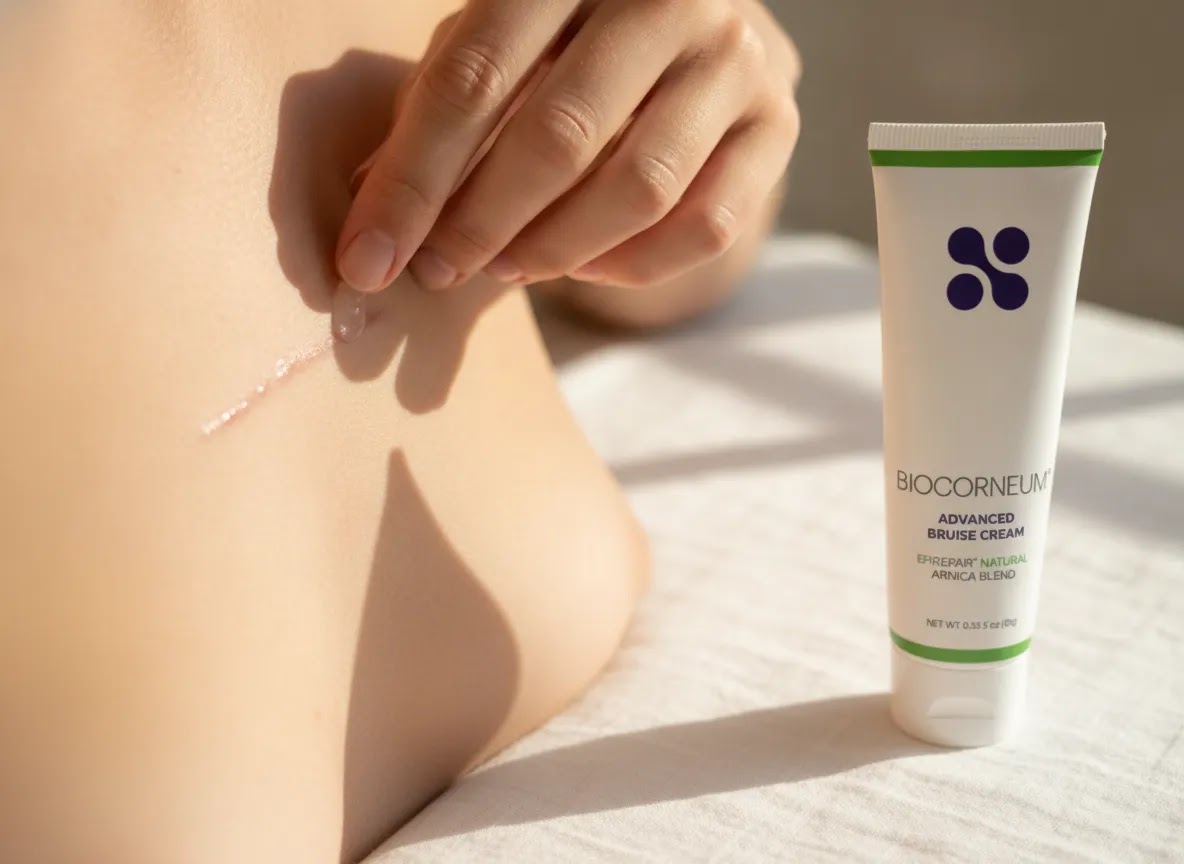
Healing skin often responds to UV light differently than surrounding skin. In practical terms, a scar may tan unevenly, stay red longer, or develop post-inflammatory hyperpigmentation. This means lingering darkening after irritation or injury. It can happen even after short time outside, especially on fresh scars and in people whose skin pigments easily.
Importantly, beach days are not the only risk. Driving, sitting by windows, walking the dog, and eating lunch outdoors can all add up. Someone may feel encouraged by early progress, then notice deeper color after a weekend of ordinary activity.
That is one reason clinicians often discuss scar care and sun care together. If you are specifically curious about visual progress over time, our article on biocorneum scar gel before and after and this related guide on how long does it take for scars to fade can help set realistic expectations around appearance changes.
For general sun-protection guidance, the American Academy of Dermatology sunscreen guide and the Skin Cancer Foundation sunscreen overview explain why daily UV protection matters.
Is biocorneum advanced scar treatment with spf 30 enough on its own?
This is one of the most useful questions to ask. An SPF 30 scar gel may be practical, but practicality is not the same as complete protection in every setting.
For many day-to-day situations, built-in SPF 30 can be a helpful baseline. This is especially true if the scar is small and exposure is modest. It simplifies the routine, and that matters because products only help when you use them consistently.
Still, some situations call for more protection. If you stay outdoors for long stretches, sweat, swim, or deal with direct midday sun, your clinician may suggest broader sun habits. For example, you may need shade, a hat, or separate sunscreen on nearby skin once your provider says layering is appropriate for your stage of healing.
What “enough” depends on
- How new the scar is
- Where it is located
- How much direct or incidental sun you get
- Your skin tone and tendency toward pigmentation
- Whether you reapply as directed if exposure continues
Built-in SPF 30 helps, but you should treat it as one part of a full sun-protection plan, not automatic complete coverage for every situation.
How to apply biocorneum advanced scar treatment with spf 30
Most application problems have little to do with the ingredient category. They usually come from technique. A silicone gel with SPF usually forms a light, even film on the scar. If you apply it like a thick cream, it may not dry well. It can pill. You may also be more likely to skip it when you are in a rush.
Thin film, even coverage, fully dry
In practice, apply a thin, even layer over the scar. Then give it time to dry before clothing, makeup, or other products touch the area. Many people underestimate drying time. As a result, they assume the product does not work because it rubs off or transfers. Letting it dry fully is a simple step that often makes the routine easier to follow.
How much to use depends on scar size
There is no single perfect amount because scar width, contour, and location vary. A practical way to think about it is to match your application to scar length so you do not over-apply:
- For shorter scars, often described as under about 3 inches, you typically need a very small amount to create a thin film.
- For longer scars, often described in the 4 to 6 inch range, you may need a bit more, but the goal is still a thin layer, not a thick coating.
If you see visible residue, tackiness that does not improve with drying time, or product balling up under makeup, you can often use less.
Common pitfalls that can make results harder to judge
- Applying too thick, which can prevent an even film and make it more likely to rub off.
- Not letting it dry before dressing, exercising, or applying makeup.
- Using it inconsistently, then expecting a steady change week to week.
- Forgetting about friction areas, such as joints, waistbands, bra lines, or areas that move constantly, where rubbing can remove product and irritate the scar.
If you are unsure whether you are applying too much or too little, a qualified provider can often tell quickly during a consultation. They can look at the scar location, movement pattern, and how your skin is tolerating the product.
How to build a real-world daily routine
The most effective scar routine is usually the one that fits your real life. Even a technically sound product will not help much if it pills under makeup, you skip it before work, or you forget to reapply on active days.
A simple approach many people can follow
- Start only after the skin is fully closed and your treating professional says topical scar care is appropriate.
- Apply a thin layer to clean, dry skin.
- Allow it to dry fully before makeup, clothing contact, or other skin products.
- Use additional sun-avoidance strategies on high-exposure days.
- Stay consistent for the duration recommended by your clinician, because scar remodeling is gradual.
Face and chest scars often raise the most routine questions because they are visible and exposed to daylight. In these areas, convenience matters. A product that combines silicone care with SPF may reduce morning steps, which can improve long-term consistency.
At Nuance Medical, patient education around scar care tends to focus on realistic routines rather than complicated regimens. If you are comparing formats, you may also want to read Epi-derm Silicone Gel Sheeting for Scars. You can also browse the Scar Treatment & Skincare category for related options.
Biocorneum advanced scar treatment with spf 30 timeline and reassessment
Scar care moves slowly, and it is easy to get discouraged if you expect a quick visual change. Scar remodeling often continues for months, sometimes longer. Day-to-day differences can look subtle. That is normal.
When people may start noticing visible changes
Every scar behaves differently. Still, many people report visible improvement around 60 days for newer scars and closer to 90 days for older scars. This assumes consistent use and careful UV protection. Remodeling can continue beyond that point, which is why people usually discuss scar care in months rather than weeks.
Think of these time markers as practical guidance, not guarantees. Location, skin tone, scar thickness, genetics, friction, and sun exposure can all change the timeline.
What “consistency matters” looks like in real life
Consistency does not mean perfection. It means building a stable routine so you can judge whether the product is helping. In many routines, that means morning and evening use with enough drying time so the product stays in place. If you stay outside for extended periods, reapplication may matter more, especially if you sweat, swim, or the area rubs against clothing.
Inconsistent use creates confusion. People often follow the plan for a few diligent weeks, then stop for long gaps. Later, they wonder why progress feels unpredictable.
When to reassess instead of simply continuing
Scar care should not feel endless. It is worth checking in with a qualified medical professional if any of the following are happening:
- The scar’s color is deepening or becoming more uneven despite careful UV protection.
- The scar seems to be thickening, raising, or becoming firmer over time.
- You are developing irritation, persistent redness, itching, or sensitivity where the product is applied.
- You are not seeing any change after a reasonable period of consistent use, particularly if your routine has been stable for a few months.
In practice, a consultation can help your provider reassess tension, friction, and sun exposure. They can also decide whether a different format, a different schedule, or an in-office option may better fit your scar’s behavior.
Quick comparison table for daily use
| Situation | What the article says |
|---|---|
| Everyday modest exposure | Built-in SPF 30 can be a helpful baseline for many day-to-day situations. |
| Long outdoor time, sweating, swimming, or direct midday sun | Extra sun-protective habits may be appropriate, such as shade, a hat, or separate sunscreen on surrounding skin if your provider approves layering. |
| Newer scars | Many people report visible improvement often begins around 60 days with consistent use and UV protection. |
| Older scars | Many people report visible improvement often begins closer to 90 days with consistent use and UV protection. |
Who may benefit most from biocorneum advanced scar treatment with spf 30
A silicone scar gel with SPF 30 often appeals to people who want daily scar support on visible or exposed areas. Common examples include a facial procedure scar, a chest scar that sees regular daylight, or a small healed incision on the shoulder where clothing does not always cover the area.
It may also suit someone who finds it hard to keep up with separate scar gel and sunscreen steps. A combined formula can make the morning routine feel more manageable.
That said, not every scar needs the same format. Some people do better with sheets, especially for broader flat areas where a dressing stays in place well. Others prefer a gel because the scar is curved, near a joint, or hard to cover discreetly. Nuance Medical also shares related scar-care education through resources such as Introducing SiliSilk™: Everyday Silicone Scar Care, Simplified, which helps illustrate why format can matter just as much as ingredient category.
What biocorneum advanced scar treatment with spf 30 may not do
People often hope one well-reviewed product will make a scar disappear. That reaction is understandable, but it creates the wrong expectation. A silicone scar gel with SPF 30 may support scar management. It does not remove established tissue or guarantee that the scar will become barely visible.
Results vary because scars vary. The cause of the scar, your skin biology, tension on the wound, location, age of the scar, aftercare habits, and sun exposure all shape the outcome. Some scars improve mostly in texture. Others improve more in color. Some remain noticeable despite careful care.
This is also why a product review or beauty award should serve as context, not a promise. If you want to see how Nuance Medical discusses product recognition in a factual way, you can read BIOCORNEUM® SiliSilk™ Wins NewBeauty Award for Best Scar Gel.
If a scar is painful, rapidly changing, reopening, or causing significant concern, a qualified medical professional should assess it rather than relying on online guidance alone.
Product authenticity and how to purchase more safely
One question comes up often with popular skincare and scar products: how do you know you are getting the real formula? Counterfeit and diverted products are a real concern across the skincare market. Packaging can look convincing, yet you still may not know what is inside or how it was stored.
Authenticity matters for two reasons. First, performance can suffer if a product was stored improperly, is expired, or is not the original formulation. Second, safety matters. If a product is altered, contaminated, or mislabeled, it may irritate healing skin.
Practical ways to reduce counterfeit risk
- Purchase through sources you can verify, such as established medical offices, clinics, or clearly identified authorized sellers.
- Check that packaging is intact and consistent, and that the product has a lot number and an expiration date.
- Be cautious if the product arrives without standard packaging, has unusual labeling, has an unexpected smell or texture, or looks different from what you have used before.
When to stop and ask a professional
If a product seems off, or if you develop irritation that does not settle quickly, stop use and check in with a qualified medical professional. That is especially important when you apply products to a newer scar, because the skin barrier may still react more easily.
If you are unsure about sourcing, a pressure-free option is to confirm with a qualified clinic or medical office before you commit to months of use. It is a small step, but it can prevent a lot of frustration.
Medical Disclaimer: This article is intended for informational and educational purposes only. It does not constitute medical advice and should not be used as a substitute for professional consultation with a qualified medical or aesthetic practitioner. Individual results vary. Always seek the guidance of a licensed healthcare professional before pursuing any aesthetic treatment.
Frequently Asked Questions
What is biocorneum advanced scar treatment with spf 30 used for?
It is generally used as part of topical scar care after the skin has fully closed. The silicone component may help support a smoother, more stable healing environment, while the SPF 30 component helps protect the scar from ultraviolet exposure that can worsen discoloration. People often consider it after surgery, cosmetic procedures, injuries, or other healed skin trauma. It is not a substitute for wound care during the open-healing stage, and a clinician should confirm when it is appropriate to start.
Why does sunscreen matter so much for a healing scar?
Healing scars are often more prone to pigment changes than surrounding skin. UV exposure can make a scar stay darker, redder, or more uneven in color for longer than expected. This is especially relevant on exposed areas like the face, chest, shoulders, and arms. Sunscreen helps reduce one common trigger for prolonged discoloration. That does not mean SPF can prevent every visible scar change, but it is a meaningful part of many scar-care routines, particularly during the early months of remodeling.
Is SPF 30 strong enough for scar protection?
SPF 30 can be a reasonable everyday level of protection for many situations, especially if it is applied correctly and used consistently. Whether it is enough depends on your exposure, the scar location, your skin type, and how new the scar is. If you are outdoors for extended periods or in strong direct sun, your provider may suggest additional measures such as shade, hats, or broader sunscreen use on nearby skin. Built-in SPF is helpful, but it works best alongside smart sun habits.
Can I start using scar gel as soon as stitches come out?
Not always. The key issue is whether the skin surface is fully closed and your treating clinician believes topical scar care is appropriate. Some people assume that once stitches are removed, any product is fair to use, but healing timelines vary. Starting too early can irritate vulnerable skin. Starting later is sometimes safer than rushing. If you recently had surgery or a cosmetic procedure, your surgeon, dermatologist, or aesthetic provider should guide the timing based on how the area looks in person.
Should I still wear separate sunscreen if my scar gel already has SPF 30?
Sometimes, yes. A combined scar gel and sunscreen can simplify daily use, which is valuable. But a scar may still need extra protection in certain settings, such as long outdoor events, exercise, vacations, or direct midday exposure. Some people also need broader sun protection over surrounding skin, not just on the scar itself. Your provider can help you decide whether the built-in SPF is enough for your routine or whether extra layering and physical sun protection would be wise.
Does silicone help with scar color or just texture?
Silicone is most often discussed in relation to supporting scar texture, thickness, and overall maturation. Color is a little different. A scar may look flatter or smoother over time but still remain visible if pigment changes persist. That is where sun protection becomes especially relevant. In a product that combines silicone with SPF 30, the formula is trying to address both the scar environment and one common reason color stays uneven. Improvement may happen gradually, and the pattern differs from person to person.
How long do people usually use a silicone scar gel with SPF?
Scar care is usually measured in weeks to months rather than days. Many people use silicone-based scar products for an extended period because scar remodeling is slow. The exact timeline depends on the scar type, location, age, and your clinician’s advice. A small facial scar may follow a different timeline than a larger surgical scar under tension. The more realistic expectation is steady, consistent use over time, with reassessment if the scar becomes more raised, darker, or otherwise concerning.
Does BIOCORNEUM actually work?
It may help, but it helps in a specific way. Products like BIOCORNEUM are generally used to support the scar’s surface environment with topical silicone, and in this version, added SPF 30 to help reduce UV-related discoloration. Many patients notice gradual improvements in aspects like texture, firmness, and color over time, but results vary significantly by scar type, location, age, skin tone, and how consistently the product is used. A qualified practitioner can help you set realistic expectations for your individual scar during a consultation.
What is better, Mederma or BIOCORNEUM?
“Better” depends on your scar goals and what you will use consistently. BIOCORNEUM is typically discussed as a silicone-based scar gel with integrated SPF 30, which can be especially relevant for scars that are exposed to daylight. Other scar products may use different active approaches and may not include sunscreen, so you may need a separate sun-protection step. If you are unsure which is more appropriate for your scar type and location, it is worth asking a qualified medical professional to assess your scar and recommend a plan that matches your skin’s sensitivity and your daily routine. If you want a direct product comparison, see Biocorneum vs Mederma.
How long should you use BIOCORNEUM on a scar?
Many people plan for months, not days. Visible improvement often begins around 60 days for newer scars and closer to 90 days for older scars, but remodeling can continue beyond that and the timeline varies. Consistent use, often morning and evening, tends to be more informative than occasional use. If you have been consistent for a few months and are not seeing any change, or if the scar is becoming darker, thicker, more raised, or irritated, it is a good time to reassess with a qualified clinician rather than simply continuing indefinitely.
Is BIOCORNEUM on Amazon real or fake?
Online marketplaces can include both authentic and inauthentic inventory, and it is not always easy to verify what you will receive. If you are buying BIOCORNEUM through any third-party source, look for clear signs of legitimacy such as intact packaging, a lot number, and an expiration date, and be cautious if the texture, smell, labeling, or packaging seems unusual. If you suspect the product is not authentic or you develop irritation, stop use and ask a qualified medical professional for guidance and safer sourcing options.
Is this type of product better for face scars than scar sheets?
A gel format often makes sense on the face because it can be less visible and easier to fit around curves, expressions, and skincare or makeup routines. Sheets may still be useful in some cases, but they can be harder to keep in place on certain facial areas. The better option is usually the one that suits the scar location and the routine you can maintain comfortably. A provider can help you choose based on scar shape, skin sensitivity, and how much sun exposure that area gets.
Can darker skin tones benefit from careful SPF scar care too?
Yes. In many cases, careful UV protection is especially relevant for people who are more prone to post-inflammatory hyperpigmentation, which is longer-lasting darkening after injury or irritation. That does not mean every person with a deeper skin tone will experience the same scar behavior, but it does mean pigment control often deserves close attention. A silicone scar gel with SPF may be one useful tool within a broader scar plan. Individual assessment still matters because scar patterns and pigment responses vary widely.
What should I do if the scar is getting more raised or darker despite treatment?
If a scar seems to be becoming more prominent, it is worth checking in with a qualified medical professional rather than simply adding more product. Some scars mature quietly, while others become thickened, more pigmented, or irritated over time. Your provider may want to assess whether the issue is sun exposure, friction, tension, sensitivity to the product, or the natural biology of the scar itself. Online information can guide your questions, but it should not replace an in-person evaluation when the scar is changing.
Key Takeaways
- Biocorneum Advanced Scar Treatment with SPF 30 combines silicone scar support with daily UV protection.
- Sun exposure can make a healing scar stay darker or more uneven in color for longer.
- Built-in SPF 30 may be helpful for everyday use, but some situations call for extra sun-protective measures.
- Scar care should begin only after the skin is fully closed and a qualified professional says it is appropriate.
- Results vary by scar type, location, skin biology, and consistency of use.
Conclusion
If you have been researching biocorneum advanced scar treatment with spf 30, the most useful takeaway is simple: the sunscreen component is not a minor extra. It is central to why this type of product may help visible scars, especially when daylight exposure is hard to avoid. Silicone may support the scar’s healing environment, while SPF 30 helps address one of the biggest reasons scars remain discolored and noticeable.
That does not make it the right answer for every scar or every stage of healing. The best routine depends on whether the skin is fully closed, where the scar sits, how much sun you get, and how your skin usually responds. A qualified aesthetic clinic like Nuance Medical can help you sort through those details in a measured, personalized way. If you want guidance tailored to your scar history and daily routine, you can explore scar-care options or book a consultation to discuss what may fit best.